Captive Audience Meetings Laws by State
 by Tom O'Dea
What are Captive Audience Meetings?A captive audience meeting is a mandatory meeting held by an employer during work hours, where employees are required to attend and listen to the employer's views, typically on topics such as unionization, politics, or religion. These meetings are often used during union campaigns to discourage union activity, with employees compelled to participate under a (typically implicit) threat of discipline or discharge.
Historically, such meetings were protected under U.S. labor law (the Taft-Hartley Act) provided they did not include explicit threats or promises of benefits. Recent legal challenges and rulings, however, are reshaping their permissibility. | Cool things you'll learn:
|
Who needs policies relating to Captive Audience Meetings?
Although a recent NLRB ruling effectively bans captive audience meetings nationwide (for union-related speech only), there is no requirement that employers must notify employees of these rights.
Of the states who have their own laws banning captive audience meetings, Connecticut, Maine, Minnesota, New York, Oregon, and Washington all require notice to employees.
The others (Alaska, California, Hawaii, Illinois, New Jersey, and Vermont) do not require notice.
We recommend you create a Religious or Political Meetings policy for at least the states that require notice. If you have a significant multi-state population or a majority of employees who are in these states, it is probably easiest to create a single Religious or Political Meetings policy for everyone.
If you don't have a presence in these states but want to communicate something to employees about the federal NLRB guidance to demonstrate your commitment to complying with the NLRA, you should create a Mandatory Meetings policy.
Model policy templates related to Captive Audience Meetings
10 Signs Employees Haven't Read the Employee Handbook (and What to Do About It)
Read the Article
The exhaustive history behind Captive Audience Meetings
In the bustling postwar America of the late 1940s, the hum of industry was more than just a sound; it was a symphony of progress. Factories were the heart of this economic renaissance, churning out everything from heavy machinery to household staples. In one such factory, owned by Babcock & Wilcox Co., the rhythm of work was steady. Rows of workers bent over their tasks, sparks flying from welding machines and the relentless clatter of assembly lines forming the background music of a burgeoning middle-class dream.
Yet beneath the surface of this industrial harmony lay a growing tension. Labor unions, emboldened by victories in the New Deal era of the mid-to-late-1930s, were pushing hard to organize workers and secure better wages and conditions. Employers, many of whom viewed unions as a disruptive force, were equally determined to keep them at bay. This clash of ideals—the workers' fight for a collective voice versus the employers' grip on control—played out in workplaces across the country, and Babcock & Wilcox was no exception.
Babcock & Wilcox (B&W), founded in 1867 in Providence, RI, by Stephen Wilcox Jr. and George Babcock and still in business today, is an American energy technology and services company with a rich history. The company was established to manufacture and market Wilcox's patented water-tube steam boiler, a design that significantly improved safety and efficiency in steam generation.
Wait, a steam boiler? What's that?
The Boiler Rooms of America: A Snapshot of 1860s Risk and Innovation
In the mid-19th century, America was a land alive with the crackle of possibility. The Civil War had ended, and a restless energy swept through the nation. Railroads snaked across the countryside, factories belched smoke into the sky, and steamboats churned through rivers, carrying people and goods to where they'd never been before. It was the dawn of an industrial era that promised wealth and progress for those bold enough to seize it.
At the heart of this industrial boom was the steam boiler: a magnificent yet menacing piece of technology. Steam boilers are what they sound like. A heat source boils water into steam, which is then put to work, usually to spin an axle by passing the steam through a turbine. In the 1860s, the axle was connected to train wheels, mills, and paddlewheel boats. Power generation didn't come until later.
Steam boilers were a marvel of their time, driving the economic engine of a growing nation. But to those who lived and worked alongside it, the boiler was a temperamental beast. It hissed and growled, its iron walls straining under the pressure of superheated steam. It required constant vigilance, like an untamed animal that might lash out at any moment.
The boilers of the 1860s were of the fire-tube variety, a design that was simple, widespread, and fatally flawed. In these boilers, hot gases from burning fuel passed through tubes immersed in water, heating the water to create steam. The design was a ticking time bomb. A single weak spot in the metal casing could turn the entire apparatus into a deadly explosion.
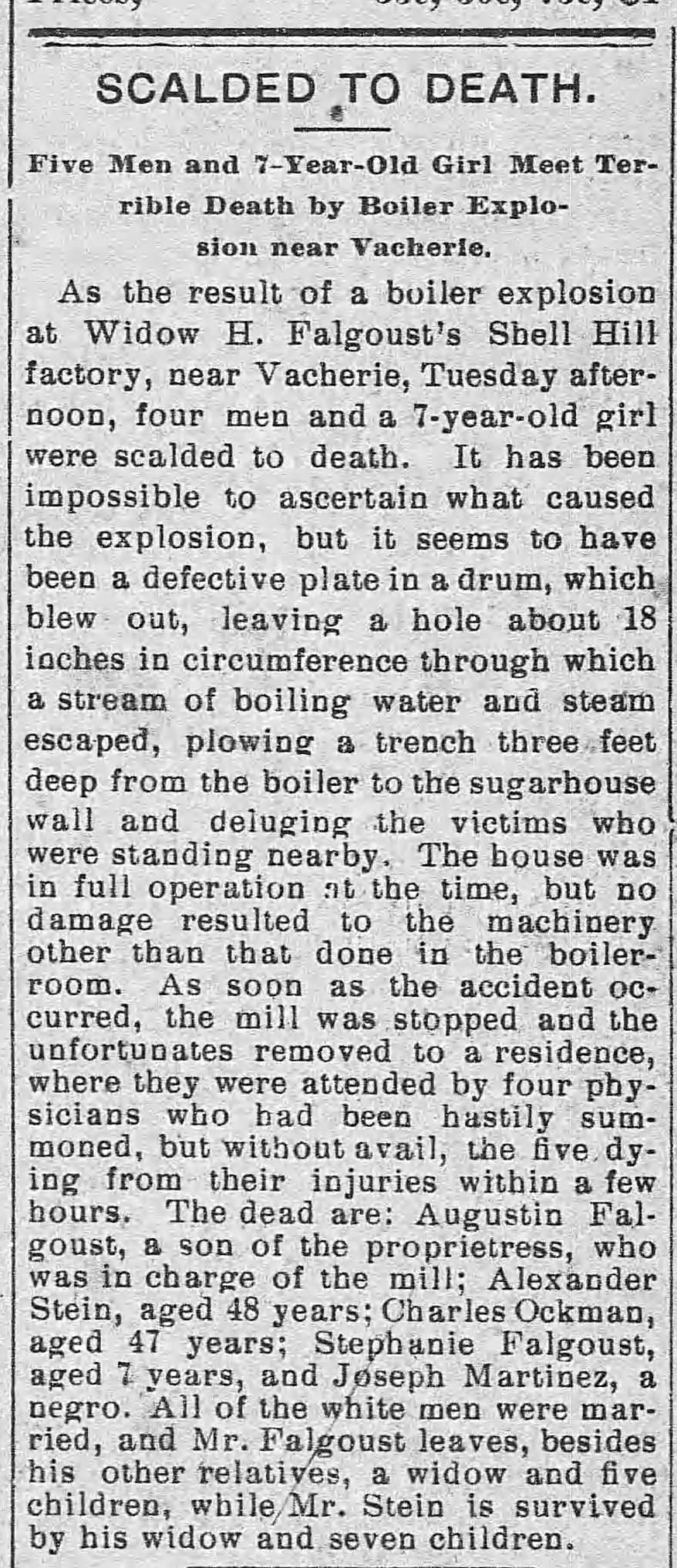
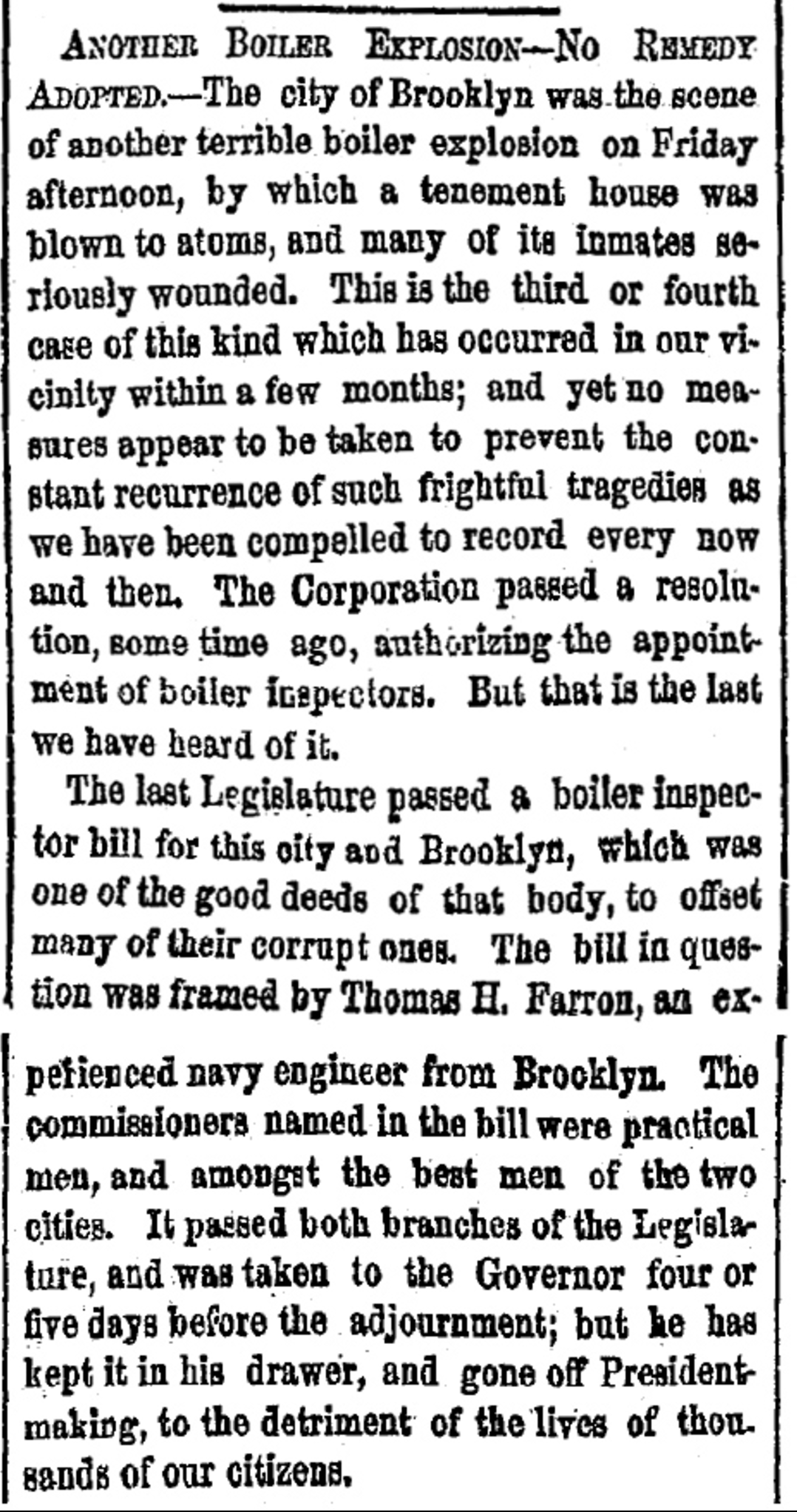
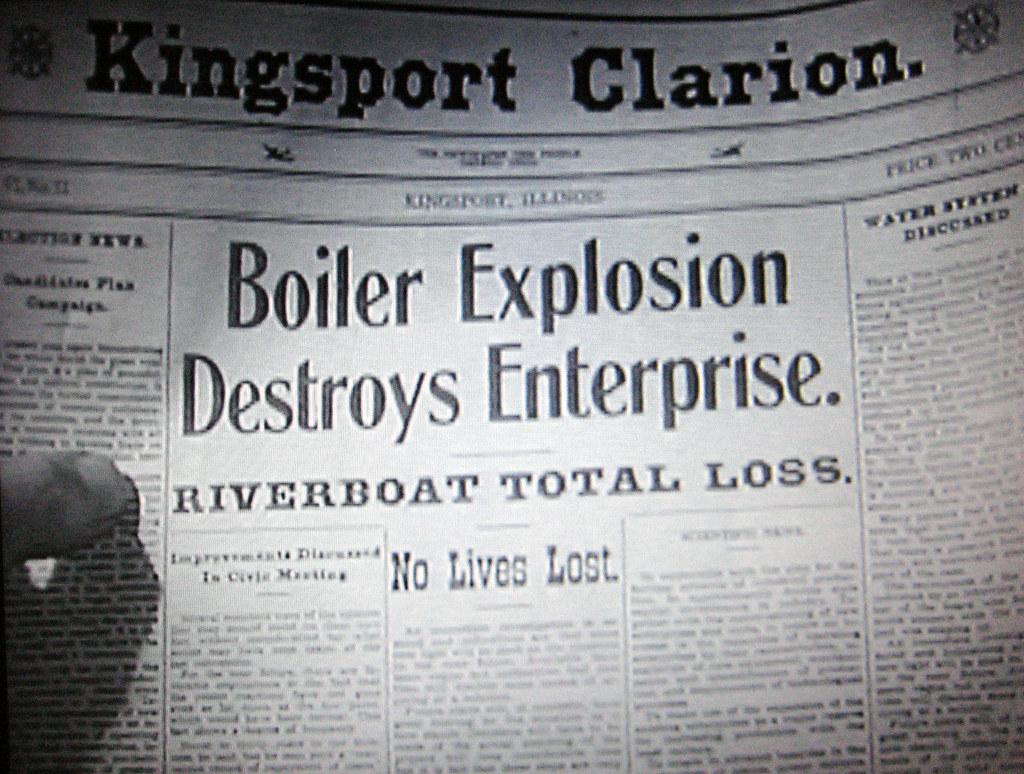
And explode they did! Newspaper headlines of the era tell the story: factories reduced to rubble, steamboats ripped apart mid-journey, and train depots scattered with the wreckage of locomotives. In 1865 alone, the U.S. had over 1,000 deaths from boiler explosions.
 |  |  |
The cause? Overheated boilers with poor pressure control, shoddy construction, or inattentive operators. The term "boilerplate", traditionally associated with strength and consistency, became synonymous with substandard work that was carelessly mass-produced.
Imagine the scene in an 1860s factory: a sprawling brick building where men, women, and even children worked shoulder-to-shoulder. In the corner, the boiler roared, its iron plates glowing with a faint red hue from the heat of the fire within. The air was thick with soot and sweat. Workers knew the risks; they'd heard the stories, or worse, seen the aftermath. And yet, the relentless march of industrialization left little choice.
Amidst this chaos and danger, there was innovation. Stephen Wilcox, a young engineer, read the headlines, too. He heard the accounts of those lost to boiler explosions and had the same thought as countless entrepreneurs throughout history: "There has to be a better way." Wilcox saw a design flaw others didn't. The fire-tube boiler trapped its pressure in the thick, iron walls surrounding the water, and when those walls failed… well… BOOM!
Wilcox and his partner, George Babcock, envisioned a groundbreaking, safer solution: a water-tube boiler that reversed the traditional design by placing the water inside tubes surrounded by hot gases. If a tube burst, the pressure released would be minimal, and the explosion that haunted so many could be avoided. In 1867, they patented their invention, ushering in a new era of safety and reliability. The water-tube boiler was a beacon of hope in a country still rebuilding from the civil war, and for the factory workers, engineers, and steamboat passengers who lived in the shadow of those old fire-tube boilers, it was salvation.
In the decades that followed, B&W's boilers powered the very engines of progress. They lit up Edison's lab, drove New York City's first subway cars, carried Teddy Roosevelt's "Great White Fleet" of naval battleships around the globe, became the heartbeat of America's naval dominance during World War II, and even played a part in the Manhattan Project. But while the machinery advanced, the workers who built them faced a different reality.
After World War II, beneath the gleaming promise of industry, a battle was brewing. And it was within these rising tensions that unions like the United Stone and Allied Products Workers of America found their purpose.
The Union That Shaped America's Stone Industry
In the early 20th century, America stood as a colossus of industry, its cities rising with steel and stone. Yet, beneath this façade of progress lay a stark reality for the workers who shaped it. In the quarries and stone yards, laborers toiled under grueling and dangerous conditions.
In the stone-cutting sheds, the air was thick with dust, leading to respiratory ailments like silicosis, a debilitating and often fatal disease that decimated communities of stonecutters. The average life expectancy for a stonecutter in Barre, VT, was just 42.
For these workers, there were no safety nets. If you fell ill, your family starved. If your boss decided to cut wages or hours, you had no recourse. Strikes were met with hostility; the granite sheds hired scabs, and the local elite saw labor unrest as an existential threat to their dominance. The booming granite industry fueled Barre's growth, but for those who shaped its stones, life was often short, harsh, and cruel. VTDigger
Amidst these harsh conditions, the seeds of collective action sprouted. The Quarry Workers' International Union of North America (QWIUNA), established in Barre in 1903 from the merger of two other quarrymen's unions, emerged as a beacon for change.
They fought to improve ventilation, restrict the use of certain dust-generating tools, and to implement safer working standards. Despite their relentless advocacy and hundreds of "he died too soon" deaths from silicosis and other respiratory diseases, it wasn't until 1939 that effective dust management finally became standard practice in granite sheds.
A few years after this hard-fought victory, the QWIUNA rebranded as the United Stone and Allied Products Workers of America (USAPWA), aiming to unify workers in not just the stone industry, but other related manufacturing industries. Wikipedia
The Babcock & Wilcox Co. vs United Stone and Allied Products Workers of America, CIO
Back at B&W's sprawling facility in the mid-1940s, USAPWA union reps saw opportunity. The factory's workforce, many of whom were immigrants or young veterans just out of WWII, had become increasingly discontented with their pay and working conditions. The union wanted to tap into this simmering dissatisfaction to unionize the workforce, but there was a problem: the company's policies. Management had imposed strict rules forbidding solicitation of any kind on company property, even during breaks. This meant union organizers couldn't approach employees in the cafeteria or hand out pamphlets in the parking lot.
From the company's perspective, these restrictions were about maintaining order. Union activities, they argued, could disrupt the workflow and sow division among employees. But for the union, and many of the workers, these rules felt like a muzzle, a way to stifle their rights under the National Labor Relations Act (NLRA) of 1935 aka the Wagner Act, passed just 10 years prior.
As tensions mounted, a series of incidents sparked the conflict that would lead to a legal stand-off. Union organizers, finding themselves barred from company grounds, began to stage their efforts just beyond the factory gates. Workers whispered about the union during lunch breaks and passed around literature in the shadows. Management cracked down by dismissing workers who were too vocal or by confiscating union materials.
The scene was set: a clash between old-school industrial authority and the rising tide of organized labor. The question that emerged from this factory floor, and ultimately made its way to the National Labor Relations Board (NLRB), was one that struck at the heart of America's evolving workplace: where does the right of an employer to control its property end, and where does the right of workers to organize begin?
The Showdown
The USAPWA began organizing at Babcock's Augusta plant in 1945. Many workers were eager for a union to address issues of pay equity and working conditions, but management was determined to retain its full control. What followed was a labor conflict that would eventually shape the limits of free speech in workplace organizing.
Superintendent Carl Claus, a seasoned manager with a smooth delivery and a folksy approach, became the voice of the company's anti-union campaign. On the other side stood workers like Haywood Kettles, a practicing pastor and advocate for the union cause, whose determination to organize his peers came at great personal cost. Between them were assistant foremen like Fred Lee Scott, whose casual comments, such as advising workers to vote "No", were anything but insignificant when viewed through the lens of power dynamics.
Between January 9 and 30, 1946, Claus delivered four speeches to employees during work hours. His words were carefully crafted but laced with undertones of coercion. "You have the right to vote as you wish," Claus intoned, before reminding workers of the company's generosity: top pay, a community-oriented reputation, and no need for a "third party" to intervene. The subtext was unmistakable: loyalty to the company was the path to security, while a union vote risked upheaval.
The speeches were mandatory—or at least felt that way to workers who understood the implicit consequences of defying company wishes. The language of the notices, though polite, left little room for choice. "All employees are asked to attend," read the announcement, a phrase that carried the weight of a command.
Kettles bore the brunt of the company's efforts to dissuade unionization. Called into Claus's office, Kettles endured pointed accusations and veiled threats: Wasn't he a friend to the company? Why risk the stability of his peers? Outside the office, another company foreman, L. H. Lemar, likened Kettles to a sinner who refused to repent. Claus escalated, suggesting that if Kettles couldn't "work with" the company, perhaps he didn't belong.
This psychological campaign against Kettles mirrored the broader effort to suppress unionization. The company painted the union as an outsider, a predatory force driven by dues collection rather than worker welfare. The message was clear: resistance was futile, and alignment with the company was the only rational choice.
On January 31, 1946, the workers voted against unionization, a decision shaped as much by Claus's rhetoric as by the underlying power dynamics. The union filed complaints, arguing that the company's conduct violated the workers' rights under the NLRA.
The case reached the NLRB, where Trial Examiner James R. Hemingway wrestled with the nuances of free speech and coercion.
Hemingway's ultimate findings were unequivocal: while Claus's words may have appeared benign on paper, their context and delivery made them coercive. The "compulsory audience" and the systemic pressure to vote against the union rendered the election results invalid. He suggested the following repercussions:
- Cease and desist from unfair labor practices, e.g. stop delivering coercive speeches and exerting pressure on union advocates.
- Invalidate the union election results.
- Post notices throughout the workplace informing employees of their rights under the NLRA, with explicit acknowledgement of the violations and a commitment to cease their unlawful practices.
- Assemble employees as done previously for anti-union speeches, but instead read the above posted notice aloud.
- Notify the NLRB's regional director that it had completed these actions within 10 days.
Case closed, right? Nope!
How NLRA Cases Work
The National Labor Relations Board (NLRB) is usually comprised of five members, appointed by the President of the US and confirmed by the Senate. However, cases are often decided by a three-member panel drawn from the Board's members.
When a complaint is filed with the NLRB alleging unfair labor practices, the case often requires a detailed examination of evidence, witness testimony, and legal arguments. A Trial Examiner (now called Administrative Law Judges, or ALJs), who is a specialist in labor law, presides over a formal hearing, similar to a court trial, to gather and analyze this information.
After the hearing, the Trial Examiner issues an Intermediate Report containing findings of fact, conclusions of law, and recommendations for resolving the case. The report is not binding but provides an informed, impartial assessment to guide the NLRB.
Because the NLRB handles a large volume of cases, delegating the initial investigation and hearing process to Trial Examiners allows them to focus on reviewing significant legal questions and policy issues. The Trial Examiner's decision gives the parties involved an opportunity to agree, object, or file exceptions before the case is escalated to the NLRB's three-member panel. This appeals step provides a formal record and arguments for the Board to consider.
Hemingway's recommendations were not the final say and, unfortunately for the B&W Co. workers, the recent NLRB case ruling he based them on, Clark Bros. Co., Inc. 70 NLRB 802 (1946), was about to be rendered moot.
Engines of Conflict: How Clark Bros. Co. Fueled a Labor Rights Battle
In the mid-1940s, the hum of industry defined Olean, NY. This small town nestled in the rolling hills of western New York had grown into a hub of manufacturing, its fortunes tied to the energy sector's relentless expansion. At the center of this industrious heartland stood Clark Brothers Co., a company with deep roots in innovation and adaptation.
Founded in 1880 by Charles E. and William P. Clark, the company began modestly, building tools for agriculture and machinery for sawmills. But by the early 20th century, the Clarks saw an opportunity to pivot. The discovery of oil in Pennsylvania and beyond was transforming the nation, and Clark Brothers Co. reinvented itself as a manufacturer of pumps and engines tailored to the booming oil and gas industry. Their Belmont facility became a regional powerhouse, producing compressors and engines that fueled the growing energy economy.
In 1912, disaster struck when a fire gutted their Belmont facility. Undeterred, the Clarks rebuilt in North Olean, strategically placing their operations closer to the expanding network of oil pipelines and refineries. This move allowed them to evolve further, producing large industrial compressors and engines vital for drilling operations.
By the 1940s, with the U.S. embroiled in World War II, Clark Brothers was a key supplier to the war effort, manufacturing equipment critical to energy production. The war had transformed American manufacturing, creating an unprecedented demand for labor and fueling tensions between workers and employers. It was a time of patriotism but also of growing labor unrest, as workers demanded fairer wages and better conditions for their contributions to the war machine.
In the summer of 1945, as soldiers were returning home and the nation began transitioning from war to peace, the employees at Clark Brothers began organizing. The company's workers were skilled but overworked, producing compressors and engines under grueling conditions. Union organizers, emboldened by the NLRA, saw an opportunity to bring collective bargaining power to Clark Brothers' workforce. The employees, facing stagnant wages and limited protections, were eager for representation.
Management, however, was determined to maintain control. Anti-union sentiment among the company's leadership mirrored a broader trend among industrialists of the time, who viewed unionization as a threat to efficiency and profitability. The tension between workers and management reached a boiling point when union organizing efforts gained traction, prompting the company to take action.
The Captive Audience Meeting (yes, we're finally here!)
The leadership team at Clark Brothers Co. implemented a strategy that would later become infamous: the "captive audience meeting." Employees were required to attend mandatory meetings during work hours, where management delivered speeches warning against unionization. The speeches were carefully crafted with no explicit threats, but the subtext was clear. Workers were reminded of the company's generosity, warned of the risks of union interference, and encouraged to maintain the "cooperative spirit" that had helped Clark Brothers thrive.
For workers, the meetings felt coercive. They understood the stakes: a vote for the union might jeopardize their relationship with management, even their jobs. What the company framed as open communication, the employees experienced as a subtle but undeniable exercise of power.
In 1946, the union filed a complaint with the National Labor Relations Board (NLRB), alleging that Clark Brothers Co.'s actions violated the NLRA by interfering with their 1,200 employees' right to organize. The case centered on whether the company's mandatory anti-union meetings constituted coercion.
The NLRB ruled against Clark Brothers, finding that the captive audience meetings were inherently coercive and violated the employees' rights under Section 8(1) of the NLRA. The decision set a powerful precedent, establishing that mandatory anti-union meetings could constitute an unfair labor practice, even if the speeches themselves lacked explicit threats or promises.
For Clark Brothers Co., the ruling was a blow to their anti-union strategy but emblematic of a broader shift in labor relations in post-war America. The company would continue to operate as a key player in the energy sector, eventually merging with Solomon R. Dresser to form Dresser-Clark in 1938, and later evolving into Dresser-Rand, only to be eventually acquired by Siemens in 2015. But the events of the mid-1940s left a lasting mark—not just on the company, but on labor law itself.
In Olean, the story of Clark Brothers Co. became one of power, resistance, and the struggle for higher standards for workers in the American workplace. The decisions made during those heated meetings would seemingly shape the future of labor relations in a nation finding its footing after the war.
The impact was fleeting, however, as it was quickly overshadowed just one year later by the arrival of a new force poised to reshape the future of labor relations for the next 64 years: the Taft-Hartley Act.
The Pendulum Swings: Taft, Hartley, and the Rebalancing of American Labor
Passed by Congress on June 23, 1947, after overriding President Harry Truman's vehement veto, the Taft-Hartley Act emerged from a growing unease about the power of organized labor in postwar America. It wasn't just a piece of legislation, it was a statement. A recalibration of the balance between labor and management at a time when the nation's economic and political future seemed precariously tied to industrial stability.
World War II had changed everything. During the 1930s, the Wagner Act had handed unions the keys to collective bargaining, and they'd used them to build powerful organizations capable of grinding entire industries to a halt. By 1946, with factories returning to civilian production and millions of soldiers pouring back into the workforce, labor unrest was rampant. That year alone saw nearly 5,000 strikes, involving almost 8% of the US workforce (4.6 million workers), and shutting down industries from coal mining to railroads. To put that into context, it'd be like if 13 million US workers went on strike in 2024 instead of the actual number—about 120,000 or 100x fewer. Employers, politicians, and the public were alarmed. Would labor's unchecked power derail the fragile postwar recovery?
Enter Senator Robert A. Taft of Ohio and Representative Fred A. Hartley Jr. of New Jersey. Taft, known as "Mr. Republican," was an intellectual heavyweight with a meticulous legal mind and a distaste for what he saw as union excesses. Hartley, a practical politician, carried the concerns of the business community in his district, where industrialists fretted over skyrocketing labor costs and strike-driven losses. Together, they crafted a bill designed not to destroy unions, but to contain them; to place boundaries around their power and restore what they called "industrial democracy."
The Taft-Hartley Act, formally named the Labor Management Relations Act of 1947, sought to reframe labor relations in three significant ways. First, it banned certain union practices, such as secondary boycotts and jurisdictional strikes, that disrupted industries beyond the immediate labor dispute. Second, it introduced protections for individual workers, allowing employees to opt out of union membership or dues in states that passed right-to-work laws. Third, and most controversially, it expanded employer rights, including the addition of Section 8(c), which explicitly protected employers' ability to communicate anti-union views, so long as their words stopped short of threats or bribes.
President Truman, a loyal Democrat, called the bill a "slave labor act" and vetoed it, claiming it stripped unions of the tools they needed to fight for fairness. But Congress overrode him decisively. The business community celebrated, unions bristled, and a new labor landscape was born.
Babcock & Wilcox Co., The Outcome
The timing of the Taft-Hartley Act could not have been more pivotal for cases like Babcock & Wilcox Co., as it was set into law about three weeks after Hemingway issued his Intermediate Report. It redefined the boundaries of what employers could say and do during union campaigns, creating a legal framework that would protect anti-union practices like captive audience meetings and sharply curtail the precedent set by earlier cases. What had seemed like a new dawn for labor rights under the NLRA was now tempered by a carefully engineered twilight.
Taft-Hartley wasn't just a law; it was a pivot point, a reaction to a postwar America trying to balance the weight of an industrial boom with the simmering tensions of class and power. For unions, it marked the beginning of a long, steady contraction. For employers, it was a victory that ensured their voices, however loud, could never be silenced in the workplace.
After almost a year of deliberation, largely due to the requirements of the newly amended NLRA, the NLRB panel flip-flopped on Hemingway's recommendations and ruled in favor of The Babcock & Wilcox Co. They faced no repercussions for their actions and could continue their strategy of discouraging unionization, including via captive audience meetings, without fear of penalties, as long as they adhered to the boundaries set by the new Taft-Hartley act.
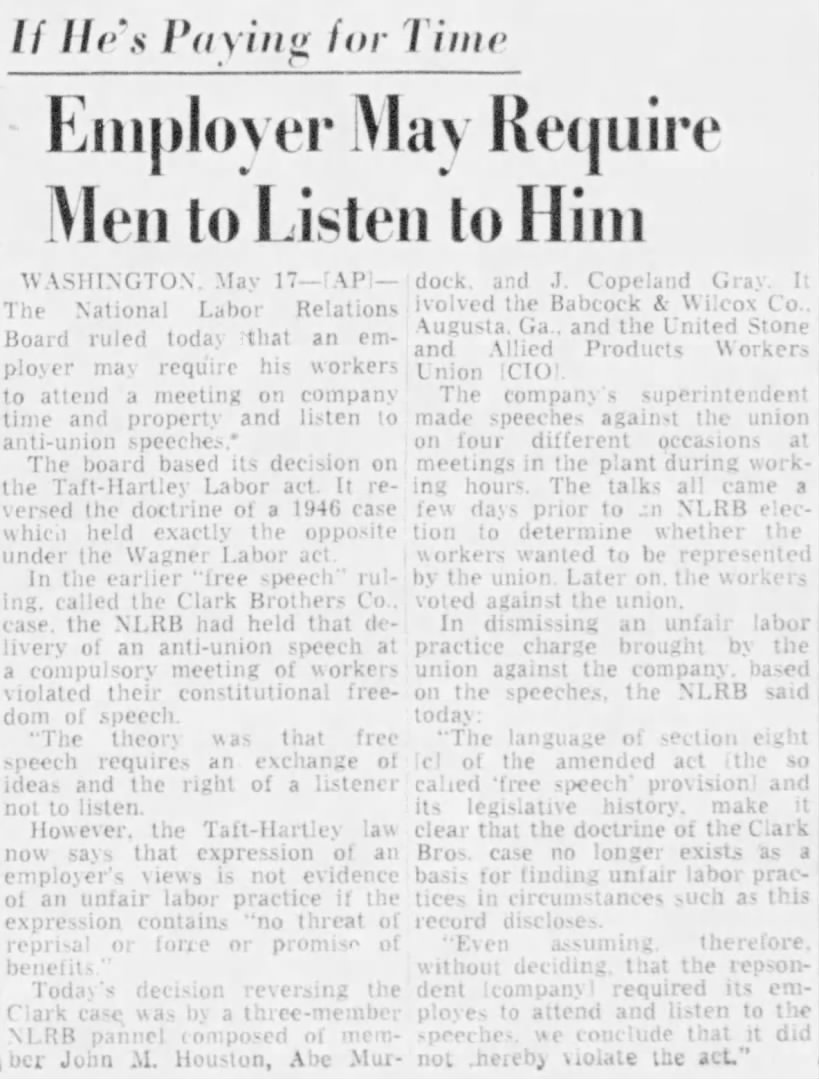
What might have been a post-Clark Brothers Co. precedent-confirming case for labor rights became a cautionary tale about the limits of reform in the face of systemic opposition. The case remains a pivotal moment in labor law, illustrating the complexities of workplace power and the delicate balance between free speech and coercion. For workers like Kettles, it was a reminder of the cost of dissent. For the company, it was a battle won but at the expense of trust and unity. And for the labor movement, it was a bittersweet chapter in the ongoing fight for fairness and representation.
Next: A Whole Lotta Nothin'
Between the late 1940s and 2010, several factors ensured that the precedent set by the outcome of the Babcock & Wilcox Co. case remained largely intact:
- The Taft-Hartley Act set the standard for what constituted protected employer speech. As long as companies avoided explicit threats or promises of benefits, they could hold mandatory meetings without violating federal labor law. Court and NLRB decisions consistently upheld this interpretation, reinforcing employers' rights to use captive audience meetings as a tool to impair union campaigns.
- States lacked the political momentum or legal frameworks to counteract federal labor law, which preempted most state-level efforts to regulate workplace conditions or labor relations.
- Union membership steadily declined in the U.S. during the latter half of the 1900s, further weakening labor's ability to push for changes to captive audience laws.
New Jersey Dips Their Toe in the Waters
In 2006, New Jersey enacted the Worker Freedom from Employer Intimidation Act, prohibiting employers from mandating employee attendance at meetings or communications aimed at conveying the employer's views on political or religious matters. However, the Act specifically excluded discussions related to labor organizations from its definition of "political matters," thereby permitting employers to require attendance at meetings addressing union-related topics.
Oregon's 2010 Law: A Turning Point
4 years later, Oregon enacted the sexily-named "ORS 659.785", a statute prohibiting employers from disciplining employees who decline to attend employer-sponsored meetings primarily intended to communicate the employer's opinions on political or religious matters, with labor organizations being included in their definition of "political matters". The law effectively banned captive audience meetings on these topics.
It marked the first successful state-level challenge to captive audience meetings and signaled a shift in labor law, as other states like Connecticut, Maine, and Minnesota explored or enacted similar legislation.
Oregon's move here also highlighted the growing state-level resistance to the dominance of federal labor standards favoring employer rights in unionization disputes.
Since Oregon enacted their law in 2010, 11 other states have enacted their own laws banning captive audience meetings: Alaska, California, Connecticut, Hawaii, Illinois, Maine, Minnesota, New Jersey*, New York, Vermont, and Washington. 7 of the 11 came online in the past 18 months alone.
*While New Jersey's law excludes labor organizations from it's definition of "political matters", the New Jersey Assembly passed a bill on October 28, 2024 to amend their definition, and it is expected to become law in the future.
The NLRB Gets Involved
On November 13, 2024, the NLRB issued a landmark decision in Amazon.com Services LLC, ruling that employers violate the NLRA by compelling employees, under even an implicit threat of discipline or discharge, to attend meetings where the employer expresses views on unionization.
The NLRB's decision overturned the precedent set in 1948 by the Babcock & Wilcox Co. case. The Board concluded that requiring employees to attend these meetings interferes with their rights under Section 7 of the NLRA, which guarantees employees the right to self-organization and to engage in collective bargaining. They emphasized that compelling attendance at meetings where employers present their views on unionization inherently carries a coercive effect, as employees may feel pressured to conform to their employer's stance to avoid potential repercussions.
However, the NLRB clarified that employers are not entirely prohibited from discussing union-related matters with employees. Employers may still hold meetings to express their views on unionization, provided that attendance is voluntary, they receive advance notice, and there are no attendance records kept.
This decision represents a significant shift in labor relations, aiming to protect employees from coercive practices that could infringe upon their rights to freely choose whether to engage in union activities. By ensuring that attendance at such meetings is voluntary, the NLRB seeks to uphold the fundamental goal of the NLRA: allowing workers to make uncoerced decisions about union representation.
Going Forward
The NLRB's ruling, which overturns a 75-year precedent, will very likely be challenged in the courts, and could eventually be overturned, especially if it finds its way to the current conservative-majority Supreme Court.
For these reasons, it's possible this blanket ban at the federal level on mandatory captive audience meetings will not survive into 2030.
Jurisdictions with laws on Captive Audience Meetings
Captive audience laws regulate an employer's ability to require employees to attend meetings or participate in discussions about topics unrelated to their job duties, such as religion or politics. These laws aim to protect employees from being coerced into listening to or engaging with topics they may not agree with or feel comfortable discussing, especially in situations where their attendance is mandatory and tied to their job security.
These laws vary by state, with some states implementing stricter rules than others.
The overarching goal is to balance an employer's right to share information with an employee's right to personal freedom in the workplace.
Although the state laws are usually broadly written, the specific mention of labor organizations in most states indicates a strong focus on protecting workers from mandatory anti-union meetings.
Reminder
The information provided here does not, and is not intended to, constitute legal advice. Only your own attorney can determine whether this information, and your interpretation of it, applies to your particular situation. Contact your legal counsel for advice on any specific legal matter.