How to Stay Up to Date With Changing Labor Laws
US labor laws change dozens to hundreds of times a year at the federal, state, and local level. If tracking those changes is part of your job, it can feel like the whole job. A rule changes in one state, a notice requirement shifts in another city, and suddenly the policies your team relied on last quarter are out of date.
Miss one update and you’ve got a handbook that no longer matches the law, plus legal risk nobody agreed to take on. And knowing a law changed is the easy part. You still have to figure out whether it applies to your organization and what needs to happen next.

The good news: staying up to date doesn’t have to mean constant Googling and checking government websites whenever someone has a spare minute. What you need is a system: a few sources you trust, a repeatable process for acting on changes, and tools that take the busywork off your plate. Here’s how to build it.
Table of Contents
Figure Out Which Labor Laws Apply to You
Staying up to date with labor laws starts with one question: which laws actually apply to your business?
Sounds obvious, but gets complicated fast. You’ve got federal labor law, state law in every state where someone on your team works, and local rules in cities and counties that create their own requirements. Remote work made it all harder. One remote hire in a new state, and you’ve picked up a whole new set of rules.
The flip side is that the same logic tells you what to ignore. You don’t need to track every legal development in the country, just the jurisdictions where you have people or operations. Map those once and you can skip the updates that don’t apply.

A centralized labor law database or labor law center helps here, especially when your team is spread across several states. Instead of piecing together requirements from scattered sources, you can look in one place and filter to the jurisdictions on your list.
Identify the Labor Law Topics Most Likely to Change
Not every labor law changes at the same pace, so don’t watch everything with the same intensity. Build a short watch list of the topics most likely to hit your policies and handbook.
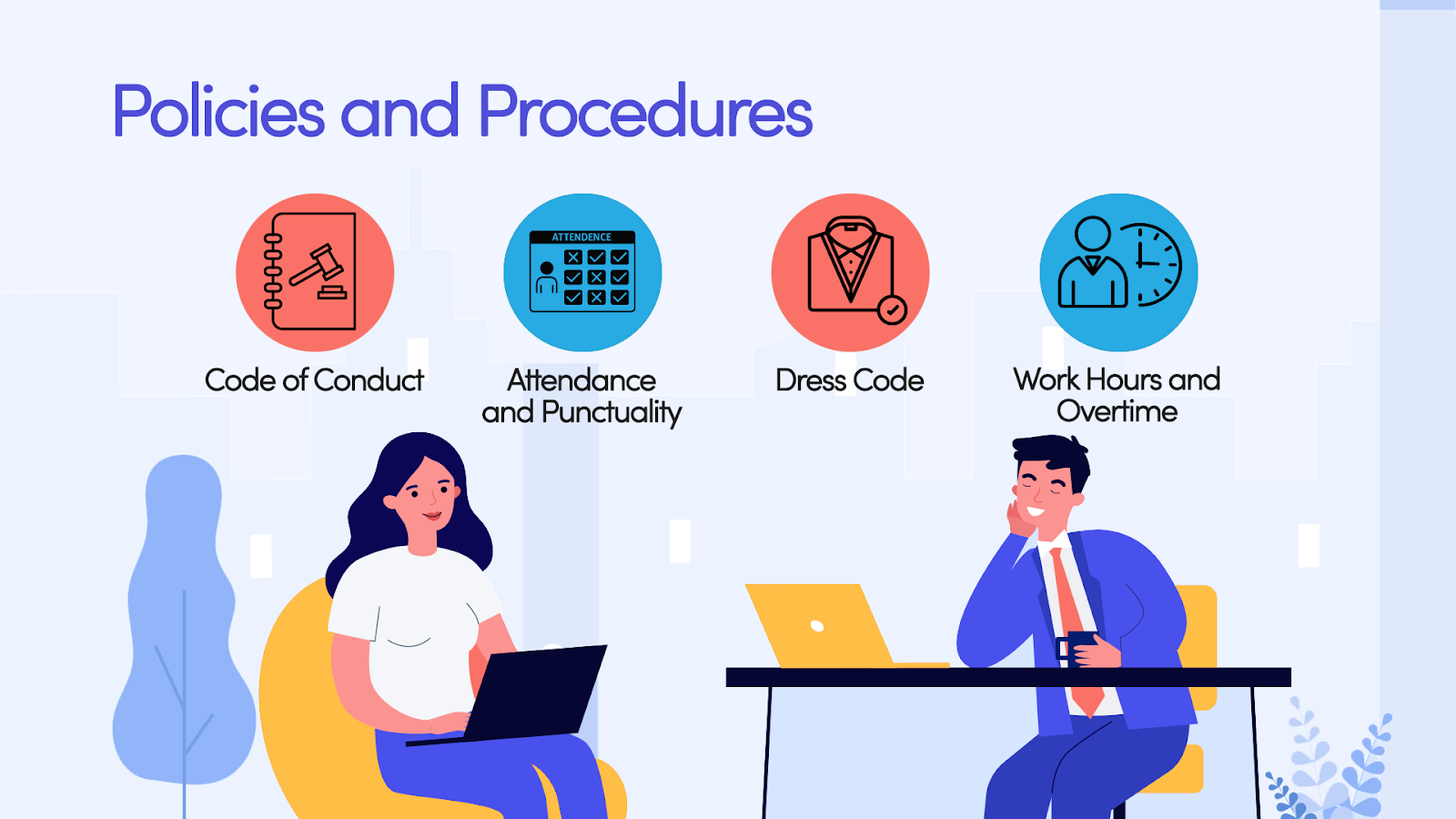
For most employers, that’s paid or unpaid leave, minimum wage and overtime, pay transparency, anti-harassment and discrimination, meal and rest breaks, employee classification, and posting and notice requirements. All of them change often, and many can vary locally.
Tune your spidey-sense to pay attention when you see changes covering these topics.
Go Straight to Primary Government Sources
The most reliable updates come from the bodies that write and enforce employment law. New laws, proposed rules, and guidance updates show up there first.
At the federal level, start with three: the U.S. Department of Labor for wages, leave, and workplace safety; the EEOC for discrimination and harassment; and the NLRB for what workplace policies can and can’t say, union or not. From there, add the state labor departments, state legislatures, and local labor offices for the jurisdictions on your list. Most federal and state agencies offer email alerts, so sign up where you can. Local sources are spottier; check those on a schedule instead.
Primary sources are built for accuracy, not convenience. Updates are scattered across dozens of websites and mailing lists, and following them all turns into a scavenger hunt for a multi-state employer. Even when you catch the right notice, it tells you what changed, not what it means for your policies. They’re essential, but don’t make them your whole system.
Governments are also not known for their speed when updating their official Codes and/or Statutes. You can find the latest info in enacted bills from each state’s legislature. Sometimes the official state Codes and/or Statutes are updated quickly, and sometimes it takes months. You’ll even find cases where the same law is published on a government site in two different places, with two different versions. Doesn’t that sound fun?
Use Trusted Secondary Sources to Add Context
Primary sources tell you what changed. Secondary sources tell you what it means: when it takes effect, who’s covered, and what needs updating.
Good ones include employment law newsletters, HR and compliance publications, industry associations like SHRM, and client alerts from employment law firms. If you have employment counsel, their updates belong on the list too.
Resist the urge to subscribe to everything. Too many alerts and the important ones get buried; a few reliable sources beat a crowded inbox of overlapping summaries.
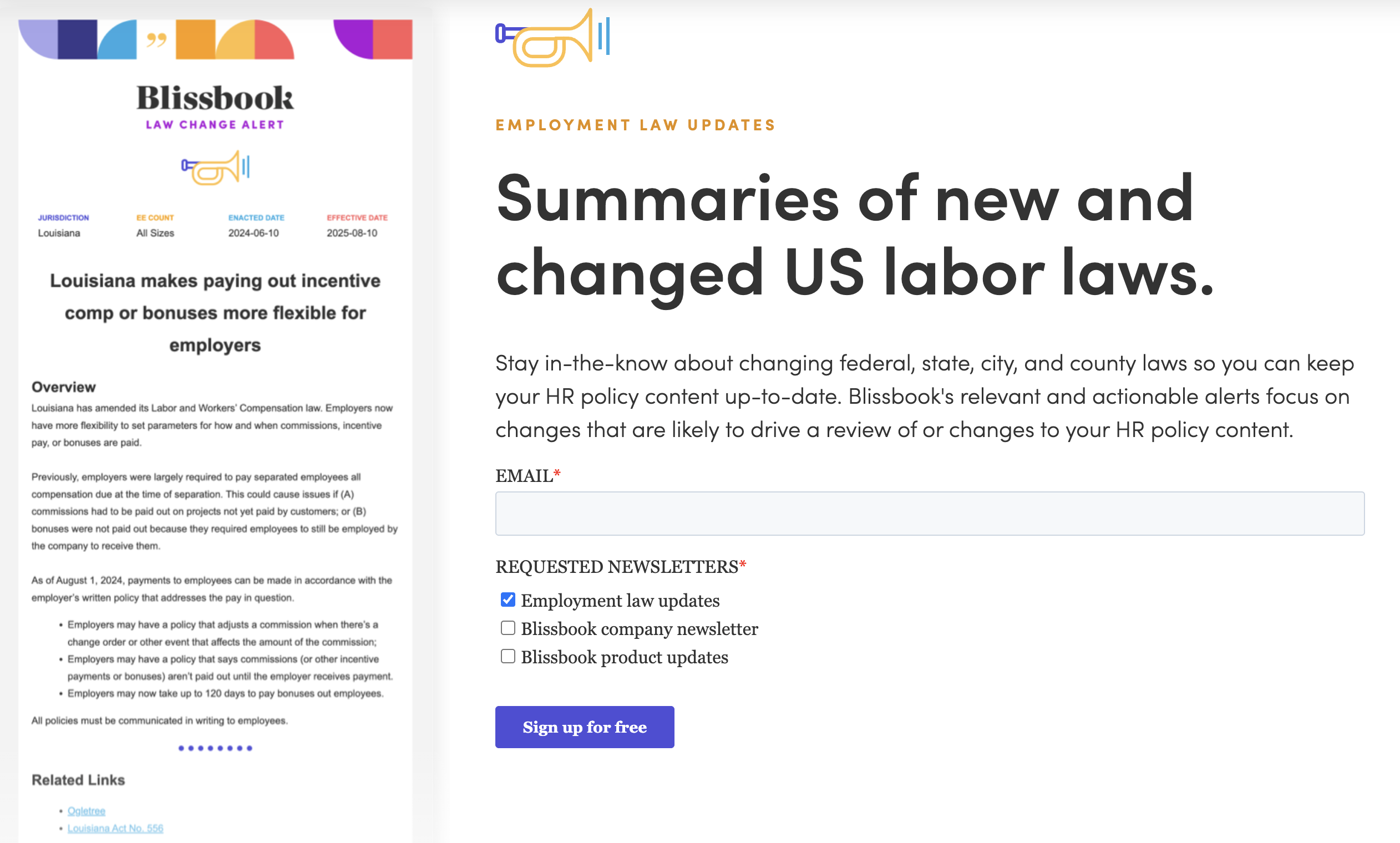
That’s the thinking behind Blissbook’s free Law Change Alerts. It’s an anti-firehose: only enacted laws likely to drive changes to your policy content, from city ordinances to federal rules. That still came to 75+ alerts last year, which tells you how fast this stuff moves.
Create an Internal Process for Tracking Legal Changes
Knowing where to look only helps if something happens next. Without a process, updates get missed and action items sit in someone’s inbox until they become urgent.
A practical process can be small:
- Assign one owner for labor law monitoring. It can sit in HR, compliance, or legal, as long as it’s someone’s job.
- Keep a shared tracker with each change, its effective date, and the next step.
- Flag which updates touch your handbook, standalone policies, your payroll system, or manager guidance.
- Set recurring review dates so follow-up doesn’t depend on someone remembering.
The payoff shows up in meetings. Instead of “someone should look into that,” every update has a name and a deadline.
The lighter the process, the more likely your team sticks with it.
Review Your Policies and Handbook Regularly
Tracking changes only counts when they reach your handbook. If everyone knows a rule changed but the policy still says otherwise, the problem isn’t solved; it’s just documented.
It usually breaks down in the middle: the team catches the update, agrees something needs to change, and then nobody touches the handbook. Managers keep giving old guidance, and HR answers the same questions by hand. That stretch between hearing about a law and publishing the fix is where risk piles up.
Regular handbook reviews close that gap, and good tools keep each review from turning into a project. Blissbook’s Legal Content Update service keeps your handbook content current as laws change. The Policy Library gives you one place to organize, revise, and reuse policies across documents, and it keeps a record of what changed over time.
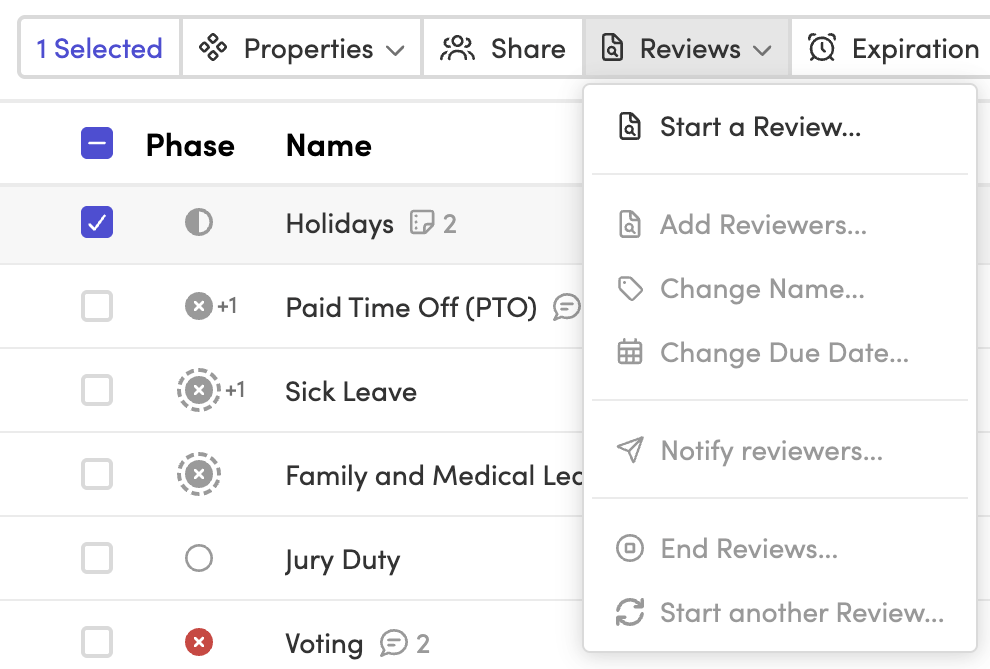
When changes need sign-off, review and approval workflows route the draft to HR, legal, or leadership with due dates attached, and you end up with a documented history of who approved what. Your employment counsel will love that part.
Use Labor Law Tools to Centralize Updates
Watching agency sites and newsletters by hand doesn’t scale, especially for a team spread across state lines. Centralized tools pull the updates into one place, and the work shifts from hunting for changes to deciding what needs attention.
The category includes law alert emails, labor law databases, and labor law centers that let you research requirements by topic and jurisdiction. A good one filters to your jurisdictions and the changes likely to touch your policies, which gets you from “something changed” to “here’s what we need to review.”
One exception: minimum wage rates change so often that your payroll provider is usually the better tracker.
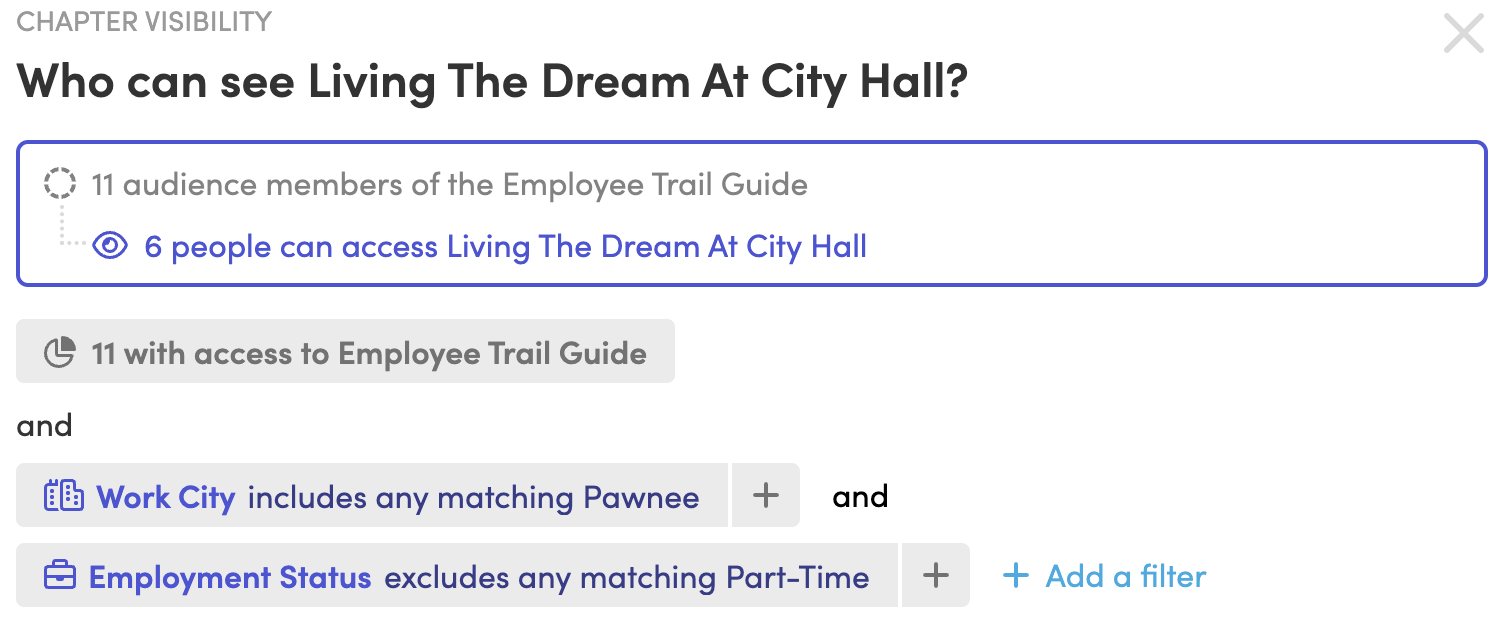
When a change does affect your people, Blissbook’s personalized content keeps the rollout precise: the updated policy language shows up only for the employee groups or locations the law covers, so you’re not maintaining a separate handbook for every audience.
Train Managers and Internal Teams on What Changed
HR tracks the updates, but HR rarely applies them alone. Managers field the employee questions, payroll adjusts rates and deductions, legal weighs the risk, and operations carries the change into daily work. If any of them are working from outdated assumptions, a well-written policy breaks down in practice.
So the rollout matters as much as the update. When the current handbook is easy to find and managers know what changed, teams answer their own questions instead of routing every one through HR.
Blissbook’s automated manager escalation makes that concrete: each manager sees who on their team has acknowledged updated documents and who hasn’t, and follow-up stops being a one-department job.
Build a Compliance Rhythm Instead of Reacting to Every Change
Compliance works better as a rhythm than as a fire drill. Put the reviews and check-ins from earlier sections on the calendar, monthly or quarterly, and the work spreads out instead of piling up around whatever deadline is scariest.
The half that gets skipped is what happens after you publish an update. Employees still need to read the change and (maybe) sign a new acknowledgement, and nobody wants to re-read the whole handbook to find the new sentence. That’s what Blissbook’s annotations are for: digital sticky notes you attach to whatever changed, and each employee sees only the notes that are new since they last viewed. They’re great when you don’t want to bug people with an email or a requirement to re-sign. And when you do ask for a new signature, the annotations will show up again, so people know exactly what they’re signing off on.
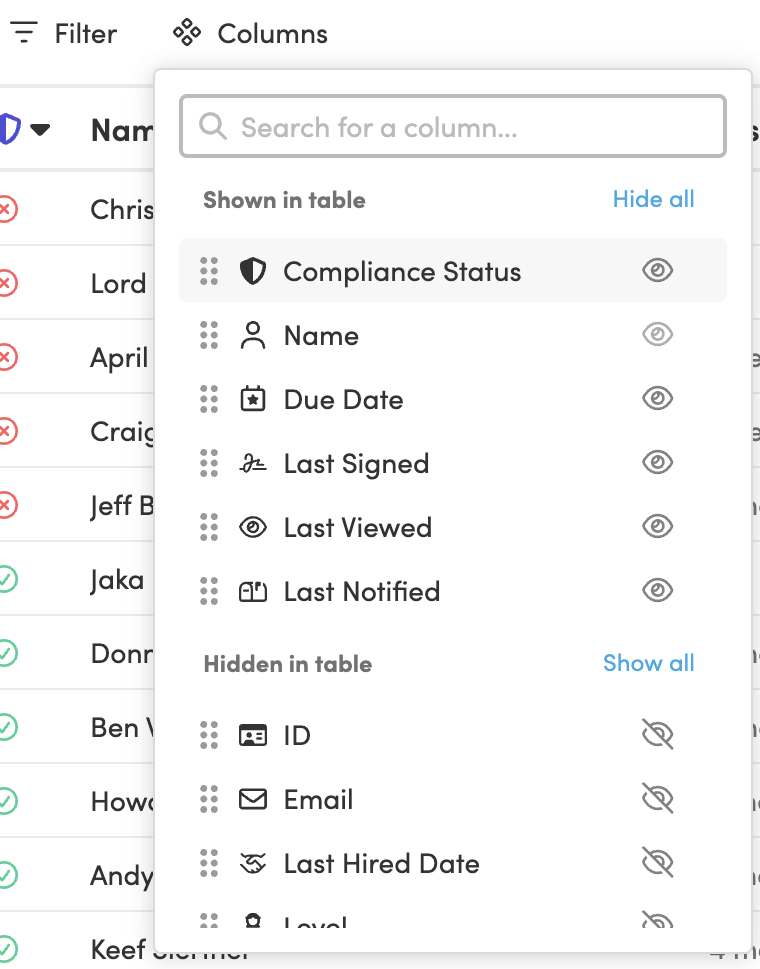
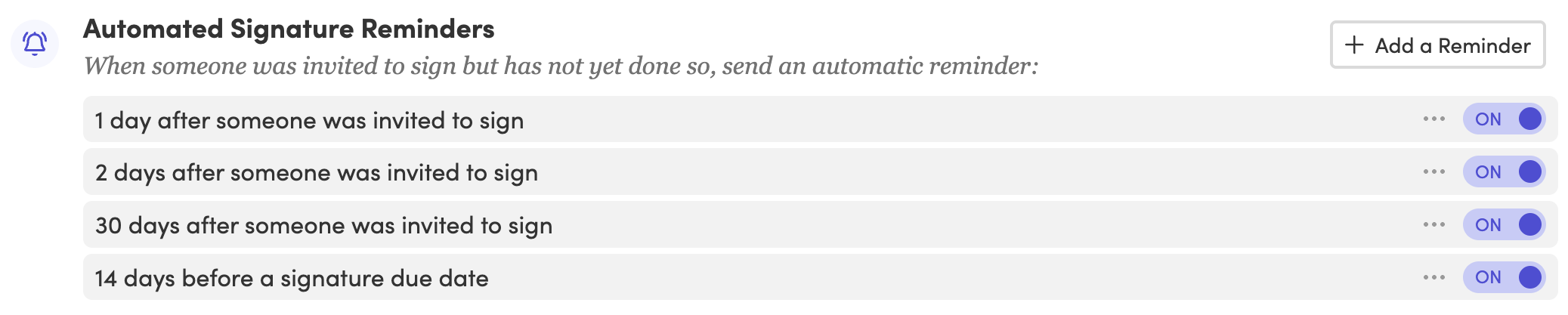
Then you need to know who’s done. The Reporting Center shows acknowledgement status and signature activity, broken down by employee group. Automated reminder emails follow up with anyone who hasn’t signed by the deadline, so nobody on your team is chasing responses by hand.
The point is proof. When someone asks whether employees saw the new policy, you want a better answer than “we sent an email.”
Final Thoughts
Labor law compliance is never finished. There’s always another update coming, and the pace isn’t slowing down.
Staying current doesn’t take heroics, though. It takes the system this article laid out: a few trusted sources, a process with someone’s name on it, and proof that changes made it all the way to your employees. Blissbook covers that loop end to end, from hearing about a change to showing who acknowledged the update.
The easiest place to start is free: sign up for Law Change Alerts, and the next law change worth knowing about will find you instead of the other way around. If you want to go even further, reach out to set up a Blissbook demo.

Angeli Pacatang
Angeli has spent two years at Blissbook helping to create clear, engaging content about HR policies and employee handbooks. Before joining Blissbook, she worked as an HR manager in the Philippines for several years, giving her firsthand experience with the challenges HR teams face. Angeli combines her practical HR background with thoughtful research and writing to make complex policies easier to understand.