How to write HR policies in 7 steps (with a template)
You have a policy deadline on Friday, but the draft is already spread across an old handbook, a manager’s document, and a legal memo. Nobody agrees which version is current, and employees still need something they can understand.
The best way to write HR policies is to work through three things in this order:
- Define what the policy needs to cover.
- Write it in plain language with a consistent structure.
- Create a reliable process for review, approval, publishing, acknowledgements, and updates.
The order matters. A polished policy with the wrong scope still creates confusion. A legally reviewed policy that employees can’t understand won’t guide daily decisions. And a clear policy that never gets approved, published, or reviewed will become outdated.

1. Decide which HR policies you need
Start with the workplace decision the policy needs to guide. A policy needs a clear job, such as explaining how employees request time off, report concerns, use company equipment, or handle conflicts of interest.
Review your current handbook, employee questions, manager escalations, recent organizational changes, and locations where you operate. Group similar topics together, then identify gaps. You may need to write a new policy, rewrite an unclear one, or separate a broad policy into a policy and a procedure.
Prioritize policies that:
- Address a recurring employee or manager question
- Apply to a large part of the workforce
- Need to reflect a change in the business
- Vary by state, location, employment status, or entity
- Depend on a specific process or decision-maker
Deciding scope first keeps the project focused. It also prevents a common problem: spending time refining language before deciding whether the policy belongs in the handbook at all.
2. Gather input before you draft
The right contributors depend on the policy, but HR should rarely write in isolation. Gather practical input from the leaders who own the work, managers who apply it, and legal reviewers who can assess the relevant requirements.
Leadership can clarify the business decision behind the policy. Managers can explain where employees get confused or where the process breaks down. Legal reviewers can identify language that needs to change based on the jurisdictions and circumstances involved.
Set boundaries before collecting edits. Decide who provides information, who recommends changes, who approves the final version, and who owns future reviews. Without those decisions, a policy can collect comments indefinitely without moving toward publication.
A shared working document can help, but use a process that preserves comments, suggested edits, and decisions. When several people need to review the same content, it helps to plan how to collaborate and get approvals for your employee handbook before the first draft goes out.
3. Write for employees, not attorneys
A policy is not meant to repeat the law. It is meant to communicate the rights employees have under the law, the organization’s own rules based on the law, and the compliance information managers need to support employees in a legal, consistent manner.
Use plain language, short sentences, and direct instructions. Employees should be able to tell what the policy means, who it applies to, and what they need to do.
Replace abstract phrases with familiar words. Define terms that employees may not know. Use active voice where possible, and explain the action instead of describing an internal process.
Before
Employees shall be expected to submit requests for approved absences through the designated administrative channel in accordance with applicable procedural requirements.
After
Employees must request planned time off through the company’s time-off system before the absence begins.
The second version tells employees who must act, what they must do, and when to do it. It also leaves room for you to link to a separate procedure if the request process needs more detail.
Plain language doesn’t mean removing necessary precision. Keep the conditions, deadlines, definitions, and exceptions employees need. Cut words that make the policy sound formal without adding meaning.
4. Give every policy the same structure
A consistent structure helps employees find answers and helps HR spot missing information during review. A practical policy template includes five parts:
- Purpose: Explain why the policy exists and what workplace issue it addresses.
- Scope: State who the policy applies to, including employees, contractors, locations, or specific groups where relevant.
- Policy: Describe the company’s rule or position in clear terms.
- Procedure: Explain the steps employees or managers must follow. Include where to submit a request, whom to contact, and what happens next when those details matter.
- Exceptions: Describe approved exceptions, who can authorize them, and how employees should request one.
You can also add definitions, responsibilities, related documents, and an effective date when the policy needs them. Keep those sections separate from the main rule so employees can find the instruction quickly.
A remote-work policy, for example, would state why it exists, which employees are eligible, how to request it, and when exceptions apply. That’s easier to use than one block of text that mixes rules with background information.
You do not need to write a policy with these 5 specific sections, in order. Feel free to weave exceptions or procedures into the rest of the content. If you have multiple people creating and editing policies and you want to enforce a common layout, use Blissbook’s AI Check. Built-in Brand Voice or Readability agents, or custom agents you define, can check a policy to ensure it follows a specific format, structure, or brand voice, and suggest changes for you to approve or reject.
5. Check state requirements and policy exceptions
Review the locations and employee groups covered by the policy before approval. A rule that works for one state or entity may need different language elsewhere.
Create a list of questions for each policy:
- Which states or local jurisdictions apply?
- Does the policy differ by employee type, work location, or entity?
- Does a collective bargaining agreement or employment arrangement affect the rule?
- Are there required notices, timelines, forms, or procedures?
- Does the policy need a state-specific addendum or exception?
Legal review is still needed before you publish a policy that addresses employment requirements. HR can organize the questions and identify where the draft may need different treatment, but only your legal reviewer can say how the law applies to your company.
Keep the core policy readable. If only part of the policy varies by location, use a clearly labeled addendum or separate section instead of making every employee read every possible rule.
Managing a separate handbook for every state? With Blissbook’s personalized handbooks, you can restrict individual policies, sections or blocks to the employees they apply to, so one document serves every location.
Is your legal reviewer too slow or expensive? Try Blissbook’s AI Check
6. Get approvals and publish the current version
Approval confirms that the policy is accurate, workable, and ready for employees. Send the final draft to the designated policy owner and legal reviewer, then record the decision and effective date.
A documented review process becomes more valuable as the number of contributors increases. Without it, HR may have several files with different comments and no clear record of which version was approved.
Blissbook, for example, supports real-time collaboration with comments and suggested edits. Review and approval workflows create a documented history of who reviewed and approved policy content. Blissbook’s version history also shows changes to sections, policies, and entire documents. Still passing drafts around by email? Blissbook’s policy management software keeps drafting, comments and publishing in one place.
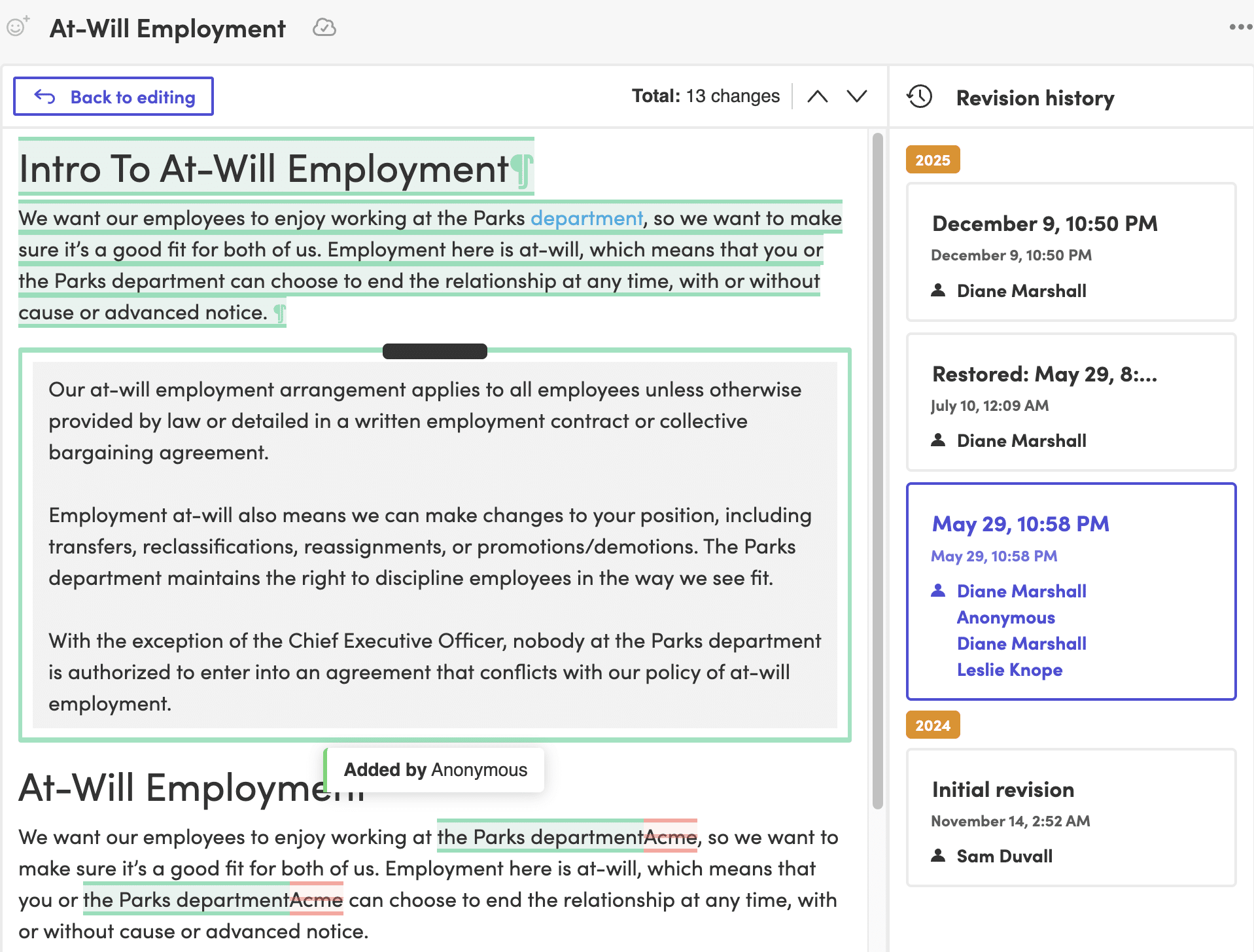
No team to help? Blissbook’s AI Check tool can be your teammate and check your policies for readability, brand voice, legal compliance, spelling & grammar, and any other custom reviewer you create.
When you publish, confirm that employees can find the policy where they normally look for workplace guidance. If the policy replaces an older version, remove confusing duplicates or clearly mark which version is current.
7. Collect acknowledgements and schedule reviews
Publishing the policy is only part of the rollout. Employees may need to acknowledge that they received, viewed, or signed the updated policy, depending on your process and the policy involved.
Tell employees what changed, when the change takes effect, and where they can read the full policy. Give managers the context they need to answer routine questions without rewriting the policy themselves.
Then assign a review owner and a review date. A review doesn’t always mean the policy needs a rewrite. It means someone checks whether the policy still reflects the company’s practices, locations, terminology, and requirements.
Blissbook collects electronic acknowledgements on handbooks and policies, records the content an employee could see when signing, and allows administrators to view that content later. Its Reporting Center shows which employees were notified, viewed, and signed each document. Want employees to see exactly what changed before they sign? Blissbook’s policy communication features let you attach notes to updated content and send automated reminders to anyone who still needs to sign.

Your review calendar needs to cover policies that change when the business changes, not only policies reviewed on a fixed annual schedule. Trigger a review when you enter a new state, change a process, adopt a new system, or receive repeated questions about the policy.
Want more depth, including advice from HR pros and employment attorneys on collaboration, drafting and sign-offs? Download our free eBook -> How to Write Policies & Procedures.
How to write HR policies FAQs
What’s the difference between an HR policy and a procedure?
A policy states the company’s rule or position. A procedure explains the steps employees or managers follow to apply that rule. Keeping them distinct makes it easier to update the process without rewriting the entire policy.
How long should an HR policy be?
An HR policy is long enough when it explains the rule, scope, procedure, and exceptions clearly. Remove background or legal language that employees don’t need, and move detailed instructions into a separate procedure when that improves usability.
Who should approve an HR policy?
The policy owner, relevant business leaders, and legal reviewers should approve the policy when their expertise applies. The approval record should identify who reviewed the content and when the final decision was made.
How often should HR policies be reviewed?
Review policies when a law, location, business process, employee group, or company system changes. A scheduled review date also helps you find policies that haven’t been triggered by a visible change.
Should HR policies include exceptions?
Include exceptions in an HR policy when they’re possible and employees need to understand how they work. State who can approve an exception, what information the employee must provide, and whether the exception must be documented.

Kamila Lipska
Kamila Lipska is a growth and digital marketing specialist with over 15 years of experience in SaaS and technology. At Blissbook, she focuses on making employee handbook, compliance, and HR communication topics easier to understand, using customer insights, search data, and real-world questions to create practical, useful content.